Hashidate Maru
The WhaleHashidate Maru was the ten-thousand-ton factory ship of Japan’s 1948 Antarctic whaling expedition, a vessel whose scale and function made it the processing center of a modern fleet. Its place in that operation shows how industrial whaling extended far beyond the catcher boats: ships, machinery, and a large crew carried the hunt into remote waters and converted captured whales into products for transport and use.
The Antarctic Expedition
In 1948, a Japanese expedition crossed six thousand miles to Antarctica with thirteen hundred crew members. Its fleet comprised six catcher boats, Hashidate Maru, two processing ships equipped to refrigerate the catch, an oil tanker, and two cold-storage vessels. The ships kept widely separated to avoid colliding with one another or with icebergs, and used radar to navigate thick fog. Hashidate Maru thus belonged to a carefully coordinated system: the catcher boats pursued whales, while the factory and processing vessels made it possible to handle the resulting catch far from land. The expedition’s size and organization marked a sharp departure from the smaller, more exposed whaling operations of earlier eras.
Capture and Processing
The fleet’s encounter with a blue whale exposed the coordinated work behind its long-range operation. A catcher boat pursued the animal, which repeatedly sounded; two hours passed before the gunner struck it. The hunters began processing the whale at the place where it was taken, because its thick blubber retained heat and the crew feared that its internal temperature could damage the carcass. The factory ship therefore served not simply as a destination for the catch but as part of an operation whose timetable and methods were shaped by the whale’s physical properties.
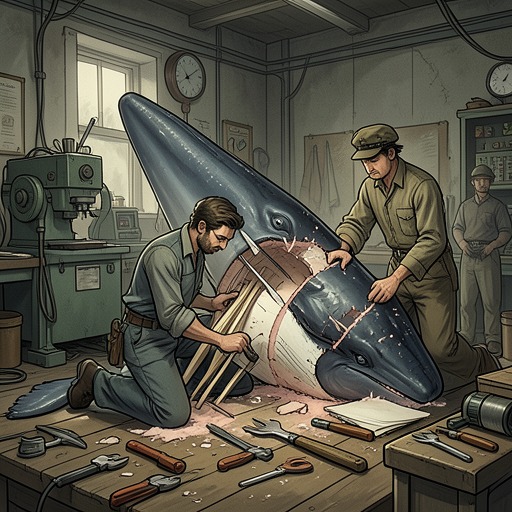
The whale was towed tail-first to a ferry-like skidway at the stern of Hashidate Maru. Eighty men worked for four hours to process it. Its weight—300,000 pounds—was established by cutting it into portions and weighing them aboard; its tongue alone weighed three tons, and its heart was described as the size of a car. These measurements turned an immense animal into a quantity the ship could handle, document, and divide, making the vessel’s machinery and labor central to the conversion of a living whale into cargo.
Rendering and Scientific Use
Below decks, steel boilers reduced blubber to oil stored in large tanks, while a separate process extracted vitamin-rich oil from the whale’s liver. The single animal processed aboard Hashidate Maru yielded 133 barrels of oil and sixty tons of meat, valued at $28,000. Nothing was treated as surplus: the ship’s systems turned different parts of the carcass into usable products, extending the logic of the hunt from capture through processing and storage. In the factory ship, the whale’s immense body became measurable output, divided among industrial uses.
The same floating factory also became a site of scientific observation. Official observers watched the work, and biologists examined dead whales to learn about living ones. The animal’s body disclosed an ecology normally concealed beneath the sea’s surface: barnacles and whale lice occupied its exterior, while intestinal parasites inhabited its gut. Hashidate Maru’s processing system made these hidden details available for study, even as it reduced the whale and its associated organisms to material passing through the ship’s production line.
That overlap between research and extraction gave the vessel a stark contradiction. Knowledge of whales was being gathered through the same industrial operation that killed them, while the flesh processed aboard the fleet could carry traces of radioactive fallout from the explosions over Hiroshima and Nagasaki. The ship thus joined distant ocean life to consequences reaching beyond the Antarctic hunt: its cargo carried both the products of whale exploitation and evidence of a wider human impact on the environment.
Industrial Scale and Ecological Consequence
Hashidate Maru belonged to a factory-fleet system whose capacity far exceeded the handling of any single catch. Such fleets could kill as many as seventy whales in a day with weapons designed to penetrate their enormous bodies. Across the twentieth century, 360,000 Blue whales were killed, reducing the population to about one thousand; by the 1960s, the species was commercially extinct. The vessel’s significance therefore lies not only in its role as a mobile processing center, but in the industrial scale it embodied: the same machinery that made remote hunting and comprehensive use of each whale possible helped drive a population toward collapse.